Connecting – today and beyond
HUBER+SUHNER logo in blue

RADOX® mCAY delivers reliable high voltage connectivity in electric vehicles 


Written by 

Marc Moser

VP Market Manager Automotive

The expansion of the commercial Electrical Vehicles (EV) market, including trucks, buses and delivery fleets, shows no signs of slowing. In fact - driven by tightening emissions rules and industry advancements – the market is expected to grow at double-digit annual rates through 2030, leading Original Equipment Manufacturers (OEMs) in a race to accelerate their electrified platform development. 


However, re-engineering commercial EV architectures around high voltage systems is no mean feat given the stringent safety requirements and electromagnetic compatibility challenges, as well as the need to package more complex components. Pair this with the indirect production costs arising from assembling and validating the components, and the problem is only compounded. Businesses now require a trusted partner to avoid falling behind.

AU connector group

How are commercial EV architectures evolving?


AU_connector_4

Commercial EV architectures are developing around higher voltage platforms and greater system integration to improve power efficiency and support the higher performance demands of heavy-duty applications.  


The voltage used in these architectures, including 400V, 800V, and beyond, is now standard in commercial EVs, and this has increased the complexity of the vehicle’s backbone. Today, high voltage systems must efficiently transfer power between several components: battery packs, inverters, e-axles, auxiliary units, and fast-charging interfaces, typically under sustained heavy loads typical of commercial duty cycles.  


This shift places new demands on vehicle power distribution networks. Components must operate effectively in harsh conditions, handling higher currents while simultaneously managing thermal build-up and maintaining electromagnetic compatibility. As a result, the integrity of high voltage modular cable assemblies is becoming fundamental to overall vehicle efficiency and operational durability. 

What are modular cable assemblies in commercial EVs?


Modular cable assemblies are built to enhance the production efficiency of commercial EVs by offering customisable, high-performance connection options. They enable OEMs to standardise high voltage integration across multiple vehicle platforms while maintaining flexibility required for evolving EV architectures.  


Think of modular cable assemblies as standardised building blocks rather than fully bespoke harnesses: pre-engineered and validated in defined configurations, they can be adapted in length, routing, shielding, and connector interfaces to suit different vehicle variants.  


These building blocks can be tailored across platforms while reducing workloads because of intuitive configuration and ready‑to‑install designs, helping to reduce overall engineering workload. Pre‑defined variants simplify system integration and eliminate the need for repeated validation cycles. 


But with operating temperatures in these vehicles often reaching up to 120 degrees Celsius (°C) – and short term peaks at even higher temperatures - how can OEMs ensure that their chosen solution is durable enough to perform in some of the harshest environments? The answer lies in RADOX® cabling solutions from HUBER+SUHNER.   

What is RADOX® mCAY for commercial EVs? 


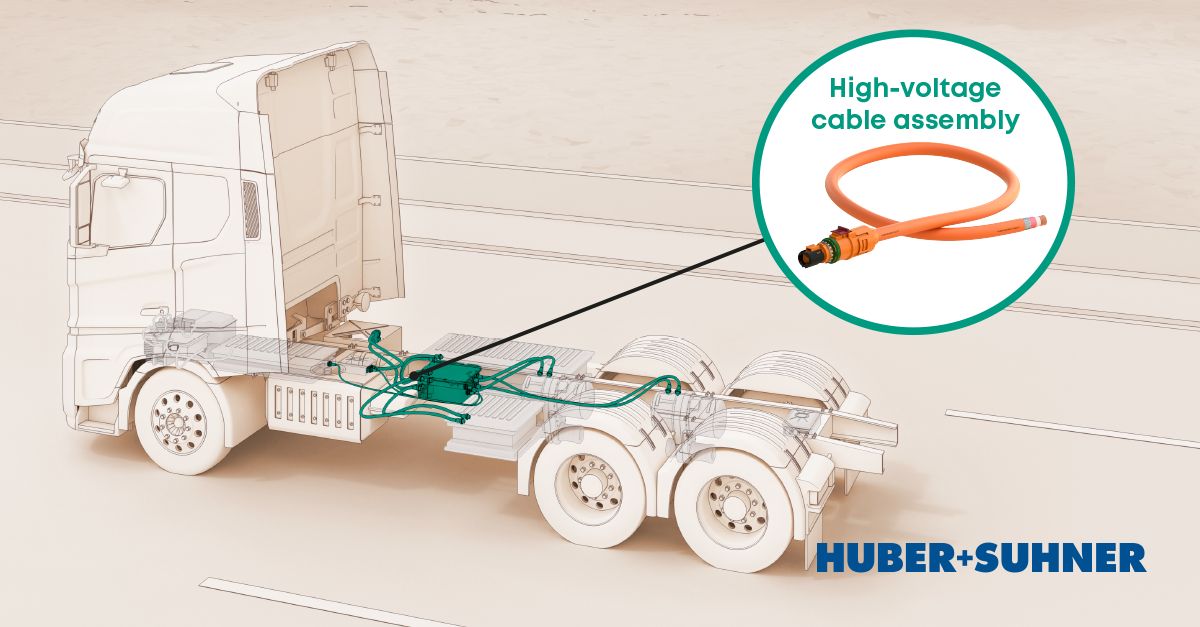
RADOX® modular cable assemblies (mCAY) from HUBER+SUHNER offer uncompromised reliability and efficiency in EV trucks, buses, and many other vehicles. Through custom cable assemblies, RADOX® mCAY has been designed to be used an off-the-shelf solution to save development efforts for OEMs.  


For example, our flagship RADOX® cables are designed for extreme durability in harsh environments and feature superior resistance to heat, abrasion, and chemicals. The cables can operate at a wide temperature range from -40°C up to 150°C, even handling peaks up to 250 °C, making them perfectly suited for commercial EV applications given their lightweight and flame-retardant properties.  


Due to the robust and excellent performance against abrasion of the cross-linked RADOX® cables there is normally no need of adding an additional protection like a tape or corrugate tube over the cable. This will help reduce the overall cost of the HV cable assembly solution, opening the opportunity to decrease the cable cross-section due to superior thermal expansion. 


The standardised mCAY design also simplifies vehicle assembly, reducing installation complexity and assembly processes thanks to accelerated homologation. Together, they create a fully integrated connectivity solution engineered to meet the evolving demands of commercial EV applications, supporting longer service life, reduced maintenance requirements, and full compliance with high voltage performance requirements.  


RADOX® mCAY’s criticality in commercial EVs has already been proven in tandem with some of the most common HV connectors in the world. Notable industry partnerships include our very own EV-C 2 solution, both HVP HD1400 and HD1000 (PowerTube) from TE Connectivity, Amphenol’s Powerlok and PowerMate as well as many more. 

Radox EV-C 2

Connecting – today and beyond


By combining proven RADOX® cable technology with a modular, pre-validated mCAY architecture, manufacturers can now streamline cost-effective vehicle development while ensuring safe and efficient power distribution across next-generation vehicles.  


Commercial EV architectures will continue to evolve toward higher voltages and greater system integration, and HUBER+SUHNER solutions will play a crucial role in delivering reliable performance for all EV types for years to come.

Get in touch

Do you have questions?

We will gladly assist you. Send us a message or find your local contact:

languageLocations worldwide
See locations