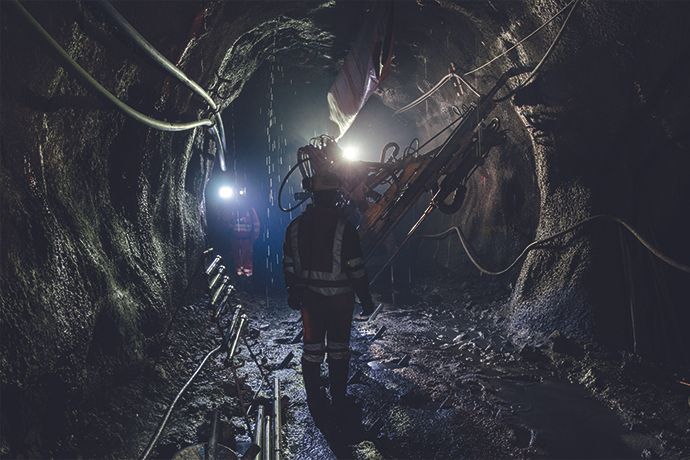
In a world of deeper mines, rising energy costs and infrastructure shortages, mining companies remain under exceptional pressure to control costs, heighten efficiency and improve safety performance. Although there is no single easy solution, it is becoming increasingly apparent that technology will play a growing role in the mining industry of the future.
As the fourth industrial revolution progresses, data connectivity is taking a more pivotal role – information from sensors, data-heavy automation solutions and data analytics must be conveyed across large distances and through challenging environments. The mining industry is deploying automation technologies at a rapid rate, meaning the demand for flexible and high-bandwidth communication is soaring.
Fiber optic networks are a critical enabler of this bandwidth, providing a bridge between devices, data processing units and control systems which are increasingly being adopted across many sectors. With fiber optics come additional benefits including immunity to electromagnetic fields, galvanic insulation and future-proof advantages with regards to bandwidth extension. But mining environments pose a risk for the physical integrity of these networks.
With mines reliant on their communications infrastructure for essential safety systems and the critical link between operations underground and those working on the surface, network failure is not an option. So how can mining companies ensure high-performance, quality, reliable and long-life solutions that enable seamless underground communication networks?