Connecting – today and beyond
HUBER+SUHNER logo in blue

Smaller cables, same current carrying capacity: the RADOX® advantage


Written by 

Jonathan Kaegi

Automotive Product Manager

As the architectural foundation of every Electric Vehicle (EV), high voltage (HV) cables are expected to deliver critical electrical performance while withstanding the harshest of environments. Historically, this was achieved through the use of corrugated tubes which acted as the solution’s main mechanical protector, shielding materials from abrasion, chemicals, moisture, and demanding operating conditions. 


However, as Original Equipment Manufacturers (OEMs) push for lighter, more compact vehicle architectures, engineers are questioning whether these oversized, archaic tubes have run their course. In fact, advancements in cable materials now make it possible to achieve better mechanical performance without the compromises associated with corrugated tubing.

Why do corrugated tubes hinder EV architectures? 


Corrugated tubes limit EV architectures by trapping heat around the cable, increasing its overall temperature and restricting heat dissipation. The higher cable temperatures caused by the corrugated tube increase its electrical resistance, leading to higher power losses and internal heat generation, creating a cycle that accelerates cable ageing.  


As a general rule, every 10 % increase in operating temperature can reduce cable lifetime by 50 %. This is commonly referred to as the 10°C Arrhenius rule, and it represents a remarkable example of how even the most modest of temperature increases can have a dramatic impact on reliability.  


Given its drawbacks, the growing sentiment among OEMs is that these corrugated tubes are now surplus to requirements. Despite some transport authorities still requiring its use, the added mass and lacklustre routing capabilities these solutions offer are preventing EV architectures from undergoing the next stage of evolution.  


Fortunately, advances in cable jacket materials have enabled an alternative approach – one in which all modern expectations for HV connectivity and weight savings can be met. By combining high mechanical abrasion resistance and heat dissipation within the cable itself, it is now possible to eliminate the need for corrugated tubing in many applications.

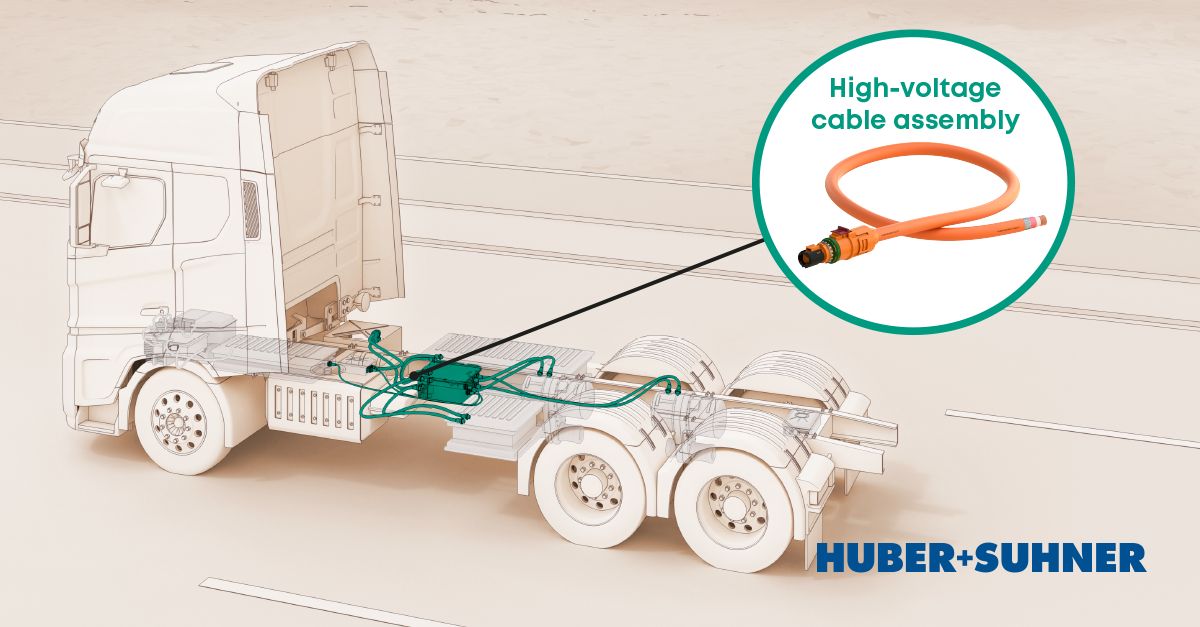
Semi truck  by Image Studio

What are the thermal benefits of using corrugate-free cables in EVs? 


This has been demonstrated by HUBER+SUHNER across our flagship RADOX® HV cable range. Rather than relying on external corrugated tubing for protection, RADOX® cables integrate exceptional mechanical resistance directly into the cable construction. 


Using an electron-beam cross-linked insulation and jacket material, RADOX® cables offer outstanding resistance to abrasion, UV exposure, weathering, automotive fluids, and continuous high operating temperatures of up to 150°C. This allows the cable itself to provide the durability traditionally achieved through additional protective tubing. 


For example, a 95mm2 high voltage cable enclosed in protective tubing can carry the same current as a 70mm2 RADOX® cable installed in free air, meaning it can dissipate heat more effectively, resulting in lower stead-state temperatures. Current-carrying capacity is improved as a result, while simultaneously reducing electrical losses and slowing thermal ageing to ultimately deliver a longer cable service life. 


Free-air routing is key here, as it allows engineers to make better use of the cable’s inherent performance. Rather than compensating for trapped heat with larger conductors, designers can optimise cable sizing based on the application’s actual thermal conditions – even giving them the freedom to reduce cable dimensions with no concerns over reliability. 

Does removing corrugated tubes help reduce of space and weight in EVs? 


Swapping corrugated tube cables for free-air routed cables helps reduce space and weight in EV platforms. RADOX® cables – which are routed in free-air – boast a smaller outer diameter and lower overall weight in comparison to cables with a corrugated tube, making it easier to route cables through compact EV platforms. 


This is crucial given the pressure on OEMs to make EV architectures more lightweight. Take the connection of a battery pack to an inverter: high currents must travel between two of the most crucial components of the architecture, and if manufacturers can use high temperature insulation, reduce insulation wall thickness, and improve cable flexibility, they can opt for a cable with a smaller diameter without compromising performance.

RADOX 155(S) / RADOX Elastomer S (FHLR91XC13X and FHLR4GC13X)

Remove your corrugated tubes with HUBER+SUHNER 


As a leading automotive supplier, HUBER+SUHNER supports customers with adopting and implementing RADOX® cables into EV platforms. Thermal behaviour is tested and modelled by our engineering teams for real installation scenarios such as free air, conduits, bundling, and ambient profiles, fully validating the solution for any scenario. 


Our leading solutions like RADOX® are paving the way for a new era of lightweight, sustainable architectures for EVs, bringing greater vehicle efficiency and lower costs to manufacturers.

Get in touch

Do you have questions?

languageLocations worldwide
See locations